
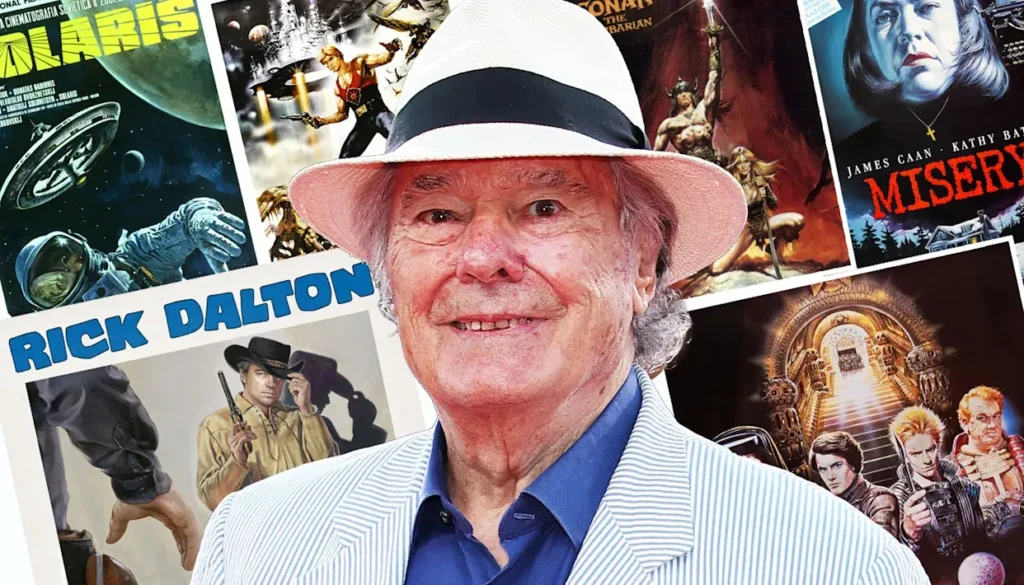
The Painter of Cinema: Remembering Renato Casaro (1935–2025)
When we think of the great cinematic illustrators, names like Drew Struzan or Bob Peak often come to mind. But in Europe, one man’s brush ruled the silver age of movie posters: Renato Casaro.
Casaro, who passed away on September 30, 2025, at the age of 89, was the last of his kind — a painter whose art could make even the most modest film feel monumental. I first saw the news through Drew Struzan’s heartfelt tribute, calling Casaro “a fellow artist whose breathtaking posters defined an era of cinema.”

Born in Treviso, Italy, in 1935, Casaro began painting film posters as a teenager — often trading art for tickets at his local cinema. After apprenticing at Studio Favalli in Rome, he went independent in the 1950s, quickly becoming a go-to artist for the Italian and international film industries. His ability to blend realism, fantasy, and pure emotion turned each poster into a story of its own.
Casaro’s brush brought to life some of cinema’s most iconic moments:
🎨 The Top 10 Renato Casaro Movie Posters
- Conan the Barbarian (1982) — Sword raised high, Arnold immortalized in oil and myth.
- The NeverEnding Story (1984) — Whimsical and cosmic, capturing imagination itself.
- Dune (1984) — Mysticism and power in one grand cosmic tableau.
- Rambo: First Blood Part II (1985) — Pure explosive energy, kinetic color and composition.
- The Last Emperor (1987) — A regal, painterly masterpiece for Bertolucci’s epic.
- Flash Gordon (1980) — Casaro turns pulp into art deco majesty.
- Octopussy (1983) — Bond elegance and spectacle, all hand-painted detail.
- Red Sonja (1985) — Heroic and fiery; the perfect visual echo of Conan’s world.
- Misery (1990) — Sparse, haunting — the lone cabin swallowed by darkness.
- A Fistful of Dollars (1964) — The beginning of the spaghetti-western mythos — and of Casaro’s legend.

Even as digital design took over, Casaro never lost relevance. His hand-painted artistry returned in Tarantino’s 2019 Once Upon a Time in Hollywood, proving his timelessness.
Beyond aesthetics, Casaro’s work reflects a vanished era — one where a brush and imagination sold a dream more powerfully than Photoshop ever could. His posters didn’t just promote films; they created mythologies.
In the words of Drew Struzan:
“Renato’s art was cinema’s soul — a reminder that we once believed movies could be painted.”
Farewell, Maestro. Your worlds will love on through the ages.
The Panelist / Panel Comics
Images © respective studios and licensors. Artwork by Renato Casaro, reproduced here under fair use for commentary and educational purposes.